The Proving Ground
The Inside Story of the 1998 Sydney to Hobart Race
May 21, 2001

Sayonara at the Start of the 1998 Sydney-Hobart Race Photo by Delly Carr / PPL
The annual 630-mile yacht race from Sydney, Australia, to Hobart, Tasmania — which draws the biggest names in sailing as well as prominent figures from other fields — has long had a reputation for being one of the most competitive and most treacherous blue-water sailboat races in the world. The belief among many yachtsmen that every seventh Hobart is subject to a special curse gained new credence three years ago when the fifty-fourth Hobart made front page news all over the world for tragic reasons. Of the 115 boats that started the race on December 26, 1998, just forty-three made it to the finish line after a tropical cyclone smashed into the fleet. Seven yachts were abandoned. Five sank. More than twenty sailors were washed overboard, and fifty-five had to be pulled from the water by helicopters and rescue ships. Six sailors met their death. It was one of the worst disasters in recent blue-water racing history.
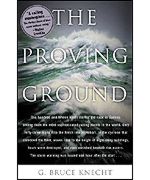
In THE PROVING GROUND: The Inside Story of the 1998 Sydney to Hobart Race, (Little, Brown and Company; July 1, 2001; $24.94), G. Bruce Knecht, a Hong Kong-based foreign correspondent for the Wall Street Journal and veteran sailor, tells the most dramatic stories of the race by focusing on three boats: the winning yacht, Sayonara, which was owned and sailed by Oracle CEO and founder Larry Ellison; the Sword of Orion, under the command of a neophyte captain; and the legendary Winston Churchill, which suffered the greatest death toll in the race.
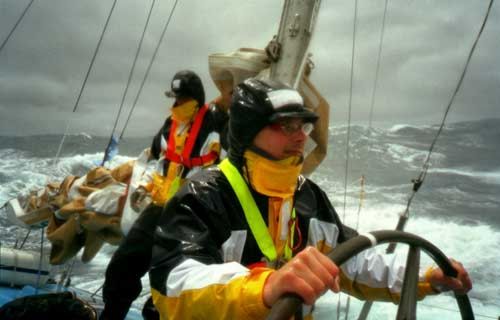
Aboard NOKIA. Photo by Ian Mainsbridge / PPL
Sayonara was the pride and joy of Larry Ellison, one of the wealthiest men in the world. A winner of the 1995 Hobart, one of Ellison's main goals in 1998 was to beat the record-breaking time set two years earlier by Hasso Plattner, his most important competitor in the software business after Bill Gates. Serving as a guest crewman aboard the yacht was Lachlan Murdoch, eldest son and heir apparent to media baron Rupert Murdoch. As the only author to interview Ellison and Murdoch, Knecht is able to reveal much about their character and motivation, and he describes Ellison's almost pathological need to win and Murdoch's inexplicable taste for danger. Despite taking a heavy beating, and with several serious injuries among her crew, Sayonara stayed ahead of the worst of the storm and was the first to reach Hobart. Nevertheless, until they completed the race, no one on board felt they were home free, and Ellison at times found himself weighing the odds that he and his crew were going to die.
The Sword of Orion, a forty-foot sloop, was owned and captained by Rob Kothe, an Australian entrepreneur known to his crew as Kooky. Kooky had an abiding hunger for the kind of glory that winning the race could bring and believed he could make up for his lack of experience with the same sort of relentless striving that had made him a successful entrepreneur. But his drive wasn't matched by a talent for managing others. When conditions forced the Sword to retire from the race, Kooky's lack of experience and failure to take firm control contributed to a dispute among crew members on whether they should leave the race to seek a safe harbor. Kooky's childhood dream for glory ended when Glyn Charles, a thirty-three year-old Olympic sailor from Britain, recruited to join the Sword's crew shortly before the race, was hurled overboard and lost at sea. After another yacht failed to come to the Sword's aid, it was only a heart-stopping rescue by Royal Australian Navy helicopters that prevented the rest of her crew from perishing as well.
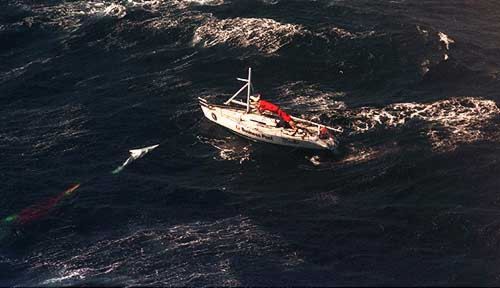
Business Post, dismasted. Photo by Jay Town / News Ltd / PPL
The Winston Churchill competed in the very first Hobart back in 1945 and was one of the best-known yachts in Australia. For her owner, Richard Winning, racing a distinguished old yacht with a crew that included several of his oldest friends was more than a sporting event or an escape from everyday life. It was a chance to reenter the natural world, to be part of a great undertaking, and to do battle with a force that was bigger than any man. The Churchill sank after being crushed by a sixty-foot wave. Not everyone would survive the thirty-hour ordeal that followed as the crew found itself adrift in a storm-tossed ocean in two decrepit life rafts. Before it went to the bottom the Churchill had managed to issue a Mayday. A nearby naval vessel rushed to the scene, but then a search plane mistakenly said it spotted the yacht in a different place. Knecht explains how the mistake was made and how it might have contributed to the death of three of the Churchill's crew.
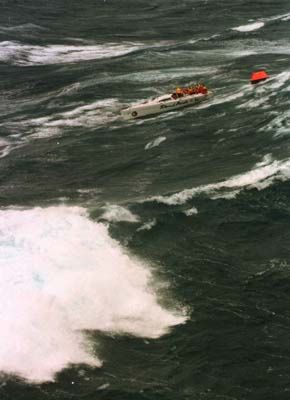
Yacht 'Stand Aside' dismasted. Photo by Ian Mainsbridge / News Ltd. / PPL
Knecht's access to hundreds of pages of official police documents, as well as separate reports issued by the Cruising Yacht Club of Australia (CYC) and the coroner of New South Wales, allowed him to paint the most complete picture to date of what went wrong during the 1998 Hobart. As he tells the story, Knecht explores all of the most important issues: the difficulties forecasters had in determining the location and course of the storm; miscommunications that occurred between yachtsmen and forecasters; and how, in at least one instance, the CYC's failure to enforce its own entry rules contributed to the death of two sailors. He also explores the impact of the move away from traditional boats with heavy keels to lightweight ones designed with the help of computers and built from space-age composite materials. As Knecht makes clear, there's a real question now as to whether some of today's grand prix yachts are truly seaworthy.
THE PROVING GROUND concludes with an analysis of what happened in the months following the race. It explores the emotional impact of the tragedy on the book's main characters as well as the ways in which the Hobart has been changed to prevent similar tragedies in the future. But no matter how many changes were made, for sailors everywhere, the 1998 Sydney to Hobart Race will forever stand as a stark reminder of the unpredictable and awesome force of the sea.
G. Bruce Knecht is a Hong Kong-based foreign correspondent for the Wall Street Journal. A two-time nominee for the Pulitzer Prize, his work has also been published in the Atlantic Monthly, Conde Nast Traveler, the New York Times Magazine, and SAIL. A graduate of Colgate University and Harvard Business School, he also has been a Reuters Fellow at Oxford University. A veteran sailor, he is a member of the Royal Hong Kong Yacht Club and the Seawanhaka Corinthian Yacht Club in Oyster Bay, Long Island.